You might come across a candidate with a spectacular resume or an employee who has mastered their skills. But if they're not the right culture fit, they might not be the right choice for your organization.
Let me explain with an example-
Apple and Google, for instance, have different work cultures. Apple strictly adheres to a hierarchical and functional structure.
In contrast, Google has a more relaxed and flexible culture. They focus on innovation, creativity, transparency, and collaboration.
Now, drop someone who thrives on structure into Google's free-flowing setup, and they'll likely feel lost, not motivated, and their performance will slip. Put that same person at Apple, though, and they'll probably settle in just fine.
But how do you determine the right culture fits among your employees or new hires? What makes a person a cultural fit for your organization? And most importantly, does it really matter?
Well, let's dive a little deeper into the concept of culture fit to find these answers.
What is Culture Fit?
Culture Fit refers to the alignment of employees with your organizational culture. It is the degree to which your employee's or potential hire's values and behaviors align with your company's core values and behaviors.
Cultural fit is typically conceptualized as the individuals' acting in ways that conform to normative expectations defined by the shared beliefs, assumptions, and values of organizational members.
– Gideon Kunda
Many companies misunderstand cultural fit as a person they would like to hang out with. At the same time, some others can be seen using it as an excuse for unconscious or conscious gender, racial, and other discriminations.
However, the real meaning of it is far beyond these narrow, biased interpretations. It is a measure of how well a person would fit in with your existing organizational culture.
Let me break it down further.
To understand the concept of company culture fit, you must consider both your employee's cognitive and behavioral aspects. The cultural fit for your organization will hold a similar set of mental representations and belief systems as your organization. At the same time, they will comply with your behavioral expectations.
The following Reddit thread is a great example of what culture fit really means:

The Key Elements of Cultural Fit
Cultural fit really comes down to three things: shared values, work style, and communication. Get these three right, and everything else tends to fall into place on its own.
1. Shared Values
To be honest, shared values is not about whether someone likes the same things you do outside of work. It's about whether their core beliefs, like what counts as good work, how mistakes should be handled, and what actually motivates people, line up with what your organization rewards.
Someone who values collaboration, dropped into a culture that quietly rewards individual credit-grabbing, will clash with the system no matter how talented they are.
2. Work Style
Some people do their best work heads-down, with clear instructions and minimal check-ins. Others need room to experiment, think out loud, and figure things out as they go. Neither style is wrong, but a mismatch creates friction fast.
Put a structure-seeker on a loosely managed, fast-moving team and they'll feel adrift. Put an autonomy-seeker on a rigid one and they'll feel boxed in.
3. Communication
How people share updates, give feedback, and handle disagreement matters more than most hiring teams realize. A culture built on direct, no-frills feedback can unsettle someone used to a softer, consensus-driven style, and the reverse is just as true. Communication style also shapes how comfortable someone feels raising a concern early, which affects how fast small problems get caught before they turn into big ones.
Taken together, these three elements decide whether someone settles in and does their best work, or spends most of their energy just trying to adjust. Hiring managers who weigh all three, not just skills and experience, tend to build teams that stay longer and work better together.
Criticism and the Shift to "Culture Add"
The core criticism of culture fit is that it works as a proxy for unconscious bias. "Would I grab a drink with this person?" measures comfort, not values, and comfort tends to favor people who already look, sound, and think like the room. Do that across enough hiring cycles and you get a team that agrees fast and can't see its own blind spots.
"Culture add" fixes the question. Instead of asking whether a candidate matches the team, it asks what they'd bring that the team is missing, a different problem-solving style, an underrepresented perspective, experience nobody else has. The company core values still have to hold. This isn't a way around values alignment, it's a way around mistaking sameness for it.
Homogeneity shows up downstream too. Vantage Circle's Recognition Analytics tracks award distribution equity by department, tenure, and location, so if hiring already skews toward one kind of person, you can catch that pattern in who gets recognized before it compounds.
That's the real shift: hire for shared values, not shared resemblance.
Benefits of Having a Defined Cultural Fit for Your Organization.
Here are some advantages of hiring and retaining good culture fits-
1. Higher employee retention:
When employees fit well within the organization, they find a sense of belonging, and employee satisfaction also gets a boost. In a Glassdoor survey, 22% of employees said that company culture and core values are the number one factors for employee satisfaction. And happy employees are more likely to stay with the organization.
2. Save you time, money, and resources:
The average cost per hire runs $5,475 for a nonexecutive role and $35,879 for an executive one, according to SHRM's 2025 Benchmarking Report. That's money you're spending all over again the moment a bad fit walks out the door.
The risk starts even before the hire is final. Deloitte's 2025 Gen Z and Millennial Survey found that around 40% of both groups have walked away from a job offer, assignment, or employer over a mismatch with their personal ethics or values, taking all the time and money you'd already sunk into that recruiting cycle with them.
We can teach someone to do a job. We can't teach someone to love the way we operate.
– Lauren Kolbe
Well, do the math. When you hire for culture fit, this cost, effort, and resource spent on constantly hiring and training new employees get reduced.
3. Cohesion:
A cohesive team that shares similar values, beliefs, and work styles works together more effectively. This results in better teamwork, collaboration, and improved morale. Therefore better performance.
4. Lesser Conflicts:
When your employees have similar communication styles, better communication, and collaboration will follow. This will reduce the chances of misunderstandings, resulting in fewer conflicts among your teams.
However, you can't see culture fit as your organization's all-in-one solution for conflict resolution. You still need to have processes in place to address conflicts when they arise. And culture fit is one such process.
How to Assess Your Culture Fit?

Well, let's be honest. Determining whether an employee or a potential hire is a great culture fit is as hard as trying to swim against a strong current.
Why? Because the "culture fit" is multi-dimensional and multifactorial. Although the behavioral perspective of the cultural fit is easy to approach, the cognitive aspect is more difficult to address.
But no worries. I am here to make the process easier for you.
1. Start with clearly defining your culture (if you haven't done already)
Your company culture is more than team-building activities, spirit week celebrations, catered lunches, and other perks and benefits. It's about what your organization stands for, the values you promote, and the goals you want to achieve.
Start with defining the company's goals, mission, and vision. Next, define core values that will serve as the foundation of your company culture. Also, do some research on what your competitors are doing.
Based on these steps, define what your ideal company culture would look like.
Related: Do you feel lost and need inspiration from companies that have aced the game? Read this blog on company core values examples.
2. Define expected behaviors
Tie cultural values to specific behaviors. This includes clearly defining the behaviors you want to reward, punish, and tolerate. Without this step, identifying cultural fit can become a case of guesswork. Moreover, it also helps your employees to understand your expectations.
Reward these behaviors and incorporate them into your reward and recognition system to get the best results.
If you don't already have a recognition system in your organization, I would highly recommend one. Wondering how it is going to help you find the organizational culture fit?
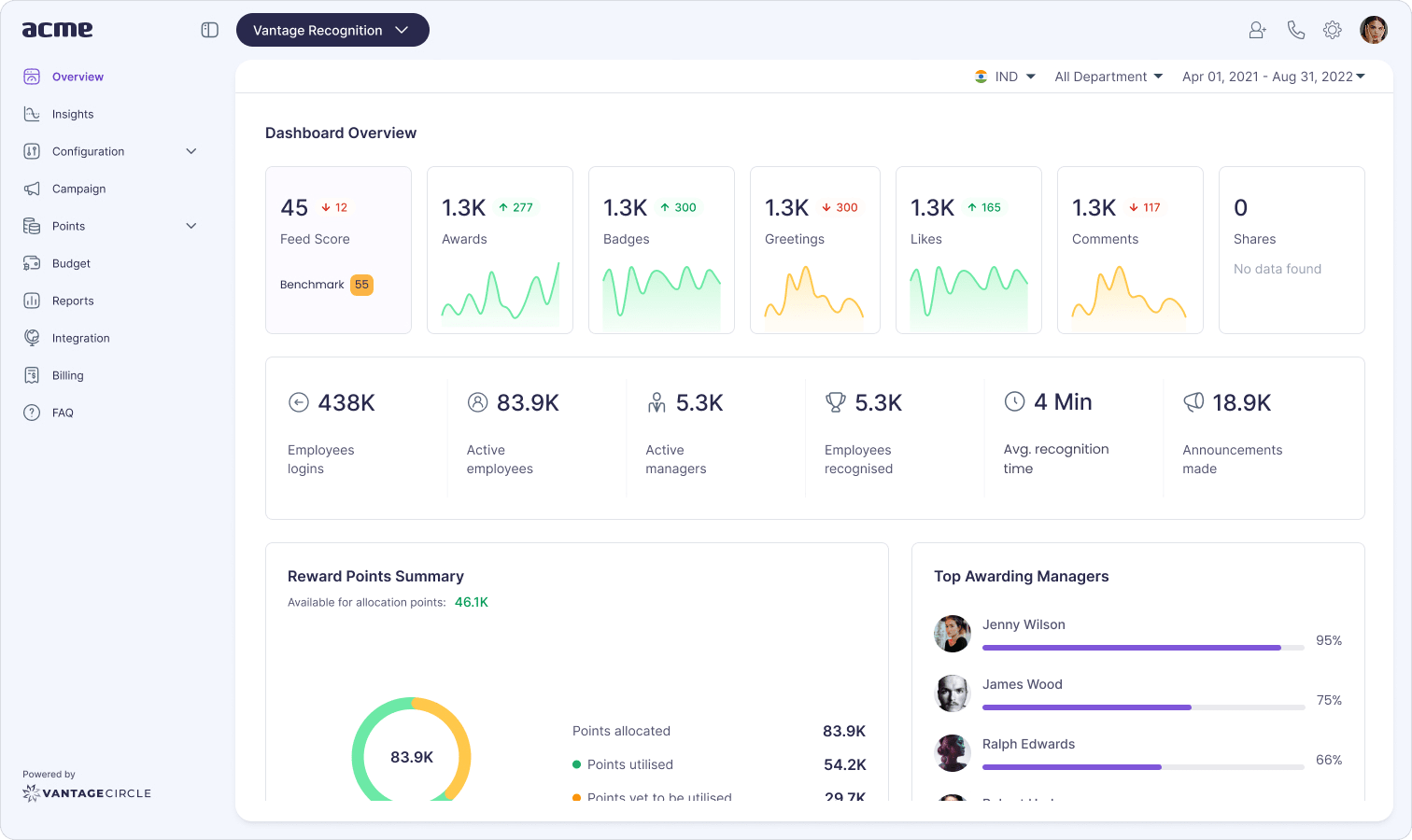
Well, an R&R solution like Vantage Recognition will give you insights into
- Which employees are recognized often for which values?
- What values are employees not recognized for?
- Who are the people who have not been recognized for exhibiting the expected values in a while?
3. Do a culture audit.
The next step will be to understand the health of your present organizational culture. To make sure everyone is on board, conduct employee surveys consistently.
A. Conduct Surveys:
To ensure your employees are on board, conduct pulse surveys. And do it consistently.
Pulse Surveys can be especially helpful in gauging how employees view and feel about your current organizational culture. It's also a great means of creating employee awareness about what behaviors you emphasize and why it is such a big deal for your organization.
In these surveys, ask your employees what they like or want to change about your present organizational culture. Analyze these survey results at the end and repeat this cycle several times throughout the year.
Use a pulse survey platform to look deeper into the data results. Vantage Pulse, for intense, offers you a hyper-categorization of data for a better visual overview. With this, you will be able to analyze employee behavior in a more structured way.
Not sure how? Let me explain with an example.
Let's say your organizational culture is focused on communication and collaboration. With Vantage Pulse, you can assess factors like employee behavior, relationships with peers, relationships with managers, alignment, team collaboration, and more from one central space.
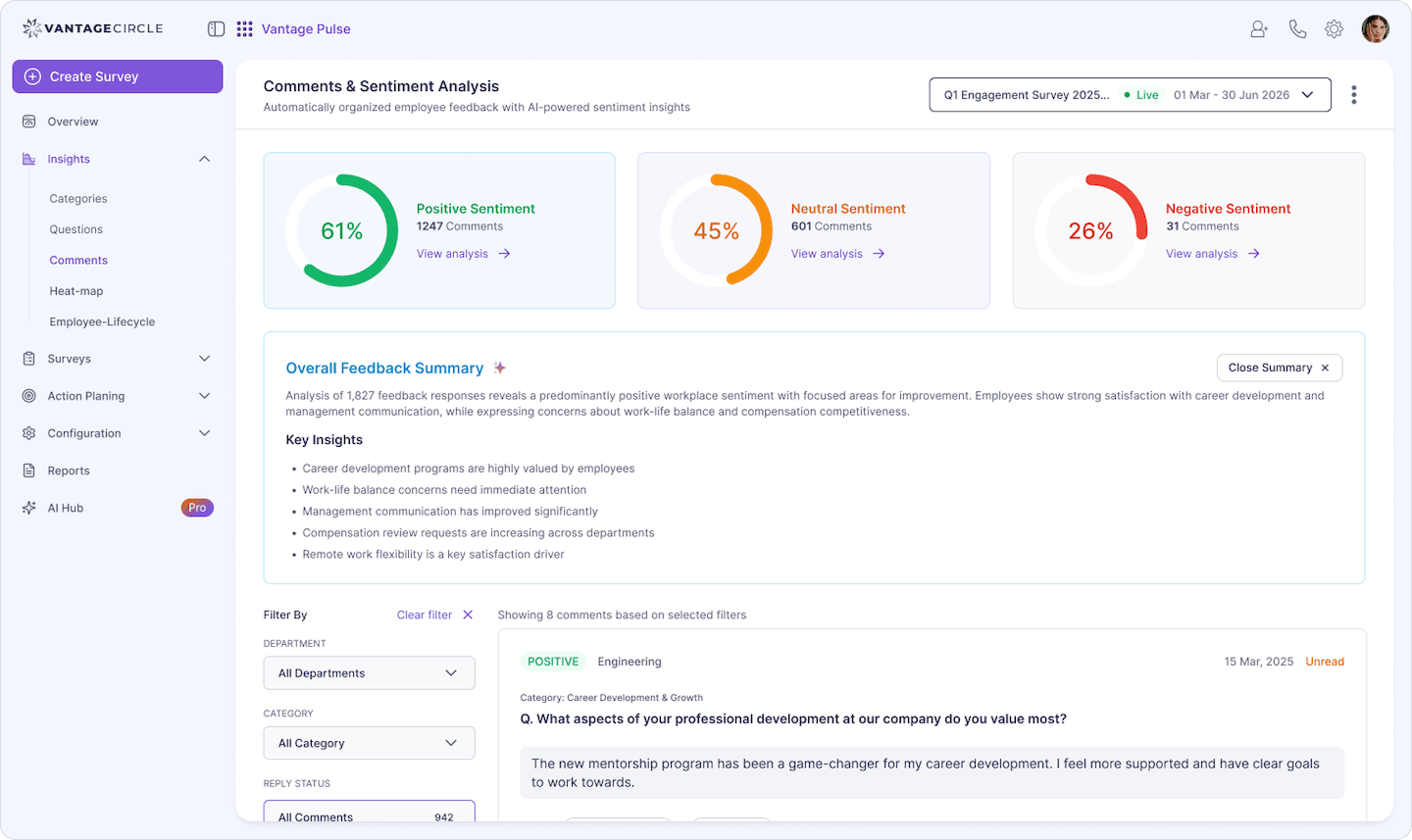
It will definitely offer you a fresh perspective and help you see your culture with your employee's eyes.
B. Talk to the managers:
Your managers are the 'guardians' of your organizational culture. They greatly influence the attitudes, values, and behavior of your teams.
Have an honest conversation with your managers about their opinions about organizational culture. You can use the survey results to guide the discussion.
4. Be okay with saying goodbye.
Now that you have a fair idea of how your employees are exhibiting the expected behaviors, here's the next question you might have-
What if an employee is not a good culture fit for your organization?
As per a poll,60% of employees didn't work well with their coworkers,- Pointing towards a poor culture fit.
In case of such cultural misalignment, the first step could be to have an honest conversation with the employee. Give them a chance to work on closing the cultural gap.
However, if the gaps persist even after that, the best step will be to let them go.
Have a clear and comprehensive policy in place that covers all possible reasons for letting someone go, including cultural misalignment.
But let's not forget that cultural misalignment isn't always the employee's fault. So, it's essential to handle the situation with sensitivity and empathy. Also, provide adequate explanation and support to the employees during the termination process.
How to Hire for Culture Fit Without the Bias Risk
According to a study, 9 in 10 recruiters reject candidates because they are not culturally compatible.
That number cuts both ways. Culture fit assessment works, but it's also the easiest place for bias to hide, since "not a fit" is a lot easier to say out loud than "not like us."
Here's how to get the upside without the risk.
Start with a real assessment, not a vibe check.
- Self-assessment tests, structured interview questions, or third-party tools all work, as long as you're comparing a candidate's actual preferences against your defined Core Values Alignment, not your gut.
- Score answers against those defined behaviors, not against how much you personally liked the person. That gap is exactly where unconscious bias sneaks in.
- Left unchecked, hiring managers tend to favor candidates who share their own background, and you lose qualified people for reasons that have nothing to do with the job.
Watch for chameleons, too. Candidates know what you're listening for, and some will shape their answers to match it, whether or not it's true. Ask for specifics ("tell me about a time…") instead of self-description, and cross-check with a work sample or reference call.
Let candidates see your culture before they apply. Social media is now the single most-used recruiting strategy, with 55% of organizations relying on it to reach candidates, according to SHRM's Talent Trends report. Candidates are on the other side of that same channel, forming an opinion about your culture before they ever apply, so make sure your social presence and job descriptions actually reflect it.
Then use the training period for what it's for. A 2025 TalentLMS and BambooHR survey of 1,156 recently hired U.S. employees found that 52% said admin-focused onboarding overshadowed job readiness. If those first weeks are all paperwork, you learn nothing about fit. Southwest Airlines does the opposite: they fly candidates in and get a read on how people behave in the room, not just what they say in it.
Employers should not assume that finding someone who is a good cultural fit simply means recruiting professionals who are similar to their current staff. Finding new candidates who are a great cultural fit does not mean sacrificing diversity but rather finding professionals from a range of backgrounds who share the values of your organization.
– Richard Boyd, Associate Director at Robert Walters
And if your teams span multiple geographies, lean toward culture add over culture fit. A single, tightly defined "fit" profile rarely travels well across locations. Done this way, the process stays tied to shared values instead of quietly becoming a search for people who look like you.
25+ Culture Fit Interview Questions
Good culture fit questions fall into six categories: shared values, work style, communication, team collaboration, adaptability, and decision-making under pressure. Ask across all six instead of leaning on two or three favorites, and you get a rounded read on a candidate instead of one lucky, or unlucky, answer.
Use this as a starting bank, not a script. Pick four or five questions per category depending on the role, and always follow up with "why" or "what happened next." The first answer is usually the rehearsed one.
| Question Category | Sample Questions |
|---|---|
| Shared Values | How would you describe your values? Tell us about a decision you made that cost you something but matched what you believe in. What does "doing good work" mean to you? Describe a workplace value you'd refuse to compromise on. |
| Work Style & Autonomy | How would you describe your most productive work environment? Do you prefer clear instructions or figuring things out as you go? Walk me through how you structure a typical workday. How much guidance do you want from a manager in your first 90 days? |
| Communication | How do you prefer to give and receive feedback? Tell us about a time you disagreed with a manager. How did you raise it? What do you do when you're not sure how a message will land? Describe how you keep a remote teammate in the loop. |
| Team Collaboration | Tell us about your best and worst experience working on a team. When it comes to teamwork, what do you enjoy most? Describe a time you had to rely on someone whose working style was very different from yours. How do you handle a teammate who isn't pulling their weight? What role do you naturally take on in group projects? |
| Adaptability & Growth | Tell us about a time a project changed direction midway through. How did you handle it? What's the most significant way you've changed how you work in the last two years? Describe a skill you had to learn under time pressure. How do you respond when a process you're used to gets replaced? |
| Decision-Making Under Pressure | Tell us about an incident when you made a mistake. What was your response, and what did you learn from it? Describe a decision you had to make with incomplete information. How do you decide when to escalate a problem versus solving it yourself? What do you do when two priorities compete for the same day? |
Shared Values
How would you describe your values? Tell us about a decision you made that cost you something but matched what you believe in. What does "doing good work" mean to you? Describe a workplace value you'd refuse to compromise on.
Work Style & Autonomy
How would you describe your most productive work environment? Do you prefer clear instructions or figuring things out as you go? Walk me through how you structure a typical workday. How much guidance do you want from a manager in your first 90 days?
Communication
How do you prefer to give and receive feedback? Tell us about a time you disagreed with a manager. How did you raise it? What do you do when you're not sure how a message will land? Describe how you keep a remote teammate in the loop.
Team Collaboration
Tell us about your best and worst experience working on a team. When it comes to teamwork, what do you enjoy most? Describe a time you had to rely on someone whose working style was very different from yours. How do you handle a teammate who isn't pulling their weight? What role do you naturally take on in group projects?
Adaptability & Growth
Tell us about a time a project changed direction midway through. How did you handle it? What's the most significant way you've changed how you work in the last two years? Describe a skill you had to learn under time pressure. How do you respond when a process you're used to gets replaced?
Decision-Making Under Pressure
Tell us about an incident when you made a mistake. What was your response, and what did you learn from it? Describe a decision you had to make with incomplete information. How do you decide when to escalate a problem versus solving it yourself? What do you do when two priorities compete for the same day?
Score answers against your defined behaviors, not against how much you liked the candidate. A likable answer and a values-aligned answer are not the same thing, and conflating them is how "culture fit" quietly turns into "culture similarity."
Notice what's missing from this list: nothing about hobbies, favorite bands, or whether they'd fit in at happy hour. Those questions measure social compatibility, not cultural fit, and they're exactly the kind of proxy that lets unconscious bias into a hiring decision undetected.
The strongest interviews mix categories deliberately. A candidate who scores well on shared values but freezes on every decision-making question isn't necessarily a bad culture fit; they might just need a role with more structure. Read the pattern across all six categories before you decide, not the answer to any single question.
Frequently Asked Questions (FAQs)
1. What is cultural fit?
Cultural fit is how closely a person's values, beliefs, and work behaviors align with an organization's existing culture. It's not about liking the same things as your coworkers; it's about whether someone's core beliefs about work match what your organization actually rewards.
2. Why is cultural fit important in hiring?
Employees who fit well tend to stay longer, collaborate better, and need less management overhead, since they're not fighting the system to get work done. Poor fits cost you in turnover, team friction, and the time spent constantly rehiring and retraining.
3. What is the difference between culture fit and culture add?
Culture fit asks whether a candidate matches the team as it already is. Culture add asks what a candidate brings that the team is missing, while still sharing its core values. Culture add exists because "fit" is easy to mistake for sameness.
4. How do you assess cultural fit in an interview?
Ask behavioral questions across categories like shared values, work style, communication, and decision-making, not just "would I want to grab a drink with this person." Score answers against defined behaviors, and back it up with a structured trial period instead of a gut feeling.
5. Is hiring for cultural fit discriminatory?
It can become that way when "fit" is used as a proxy for sameness, screening out candidates who don't share an interviewer's background rather than candidates who lack the organization's values. That's the core criticism behind the shift toward culture add.
6. What are examples of cultural fit?
Apple's hierarchical, structured culture and Google's flexible, collaboration-first culture are two well-known contrasts. A person who thrives with clear direction fits one; a person who wants autonomy and room to experiment fits the other, even though both cultures value strong performance.
To wrap it up:
To ensure you're setting yourself and your team up for success, frequently assess your processes. For instance, a survey after three months of joining will be a great move if you have a new hire on board.
Hiring, retaining, and assessing culture fit might take a little extra time and effort from your side. So rather than doing things manually, invest in a survey tool. It will automate your assessments and make a strategic action plan with data-driven analytics.
It'll pay off with professionals who thrive in their roles, drive long-term success, and make your organization unstoppable.

Sanjeevani Saikia is a Senior Content Strategist at Vantage Circle, where she leads end-to-end content strategy across SEO, thought leadership, brand storytelling, podcasts, and video. She is also the host of the Vantage Influencers Podcast, where she brings conversations with HR and business leaders from top global organisations, including Fortune 500 companies.
Connect with Sanjeevani on LinkedIn.