Search "employee recognition letter" and most of what comes back reads the same: thank you, great job, keep up the good work. None of it says what the person actually did. That's usually because whoever's writing it is doing it under deadline pressure, with no example in front of them, and reaches for the safest, vaguest praise available.
This post has 10 recognition letter examples that try to do better, each one usable as a recognition letter template you can adapt in minutes. It includes one most lists skip entirely: a letter written up to a manager, not down to an employee. You'll also get 5 tips for writing a letter of recognition from scratch, plus a look at what happens when recognition stops living in a letter and starts showing up in real time.
What Is an Employee Recognition Letter?
An employee recognition letter is a written note from a manager, peer, or leader that formally acknowledges an employee's specific contribution or achievement. Unlike a quick verbal thank-you, it creates a lasting record the employee can point back to, one that names exactly what they did and why it mattered.
It can come from a manager after a strong quarter, from a peer after a project wraps up, or from an employee thanking a manager who went out of their way to support them. What makes it work isn't the letterhead or the formatting. It's specificity: naming the actual behavior, not a generic label like "great job."
Why Does an Employee Recognition Letter Matter?
An employee recognition letter matters because a lot of employees don't feel like their work is actually seen. Only 62% of U.S. workers say their contributions at work are valued a great deal or a fair amount, meaning nearly 4 in 10 fall short of even that middle bar (Pew Research Center, 2023). That gap shows up in retention too: SHRM's research on employee experience found that only 9% of employees with a positive work culture considered leaving their job, compared to 42% of those with a negative one (SHRM, 2024).
A recognition letter closes part of that gap, and it costs nothing but the time it takes to write one. The effect on the employee who receives it outlasts the day it arrives, their morale and job satisfaction start reflecting that someone actually paid attention, not that a survey told a manager to. That attention compounds into sustained motivation and a lower chance the person quietly starts job hunting because nobody noticed what they did.
That's easy to say and easy to skip in practice. Recognition usually loses out to whatever feels more urgent that week, a deadline, a hiring gap, a client fire, and it keeps losing until someone notices the pattern in exit interviews or an engagement survey. Writing one letter doesn't fix a culture problem, but it's a concrete, no-cost first step that a manager can take today, without waiting for a program or a budget line to approve it.
Key Elements of a Great Employee Recognition Letter
A great employee recognition letter has five elements in common: personalization, specificity, positive language, sincerity, and timeliness. Skip any one of them and the letter starts to read like a template, even a well-written one.

Personalization
Address the employee by name and write to them directly, not to "the team" or "whoever reads this." A letter that could be sent to anyone on the floor doesn't feel like recognition, it feels like a form.
Specificity
Name the exact accomplishment or behavior, not a general impression of it. "Thanks for your hard work this quarter" could describe anyone. "Thanks for catching the billing error before it reached the client on Friday" describes one person, doing one thing, on one day.
This is also where a company's stated core values can do real work. Tying the praise to a value the company has actually said it cares about (ownership, collaboration, customer focus, whatever it may be) turns a nice sentence into something that reinforces what the organization is trying to build, not just a compliment in isolation.
Positive Language
Use language that sounds like a person said it, not a policy document. Enthusiasm reads as genuine when it's specific; it reads as hollow when it's the only thing in the sentence.
Sincerity
Write only what you mean. Employees can tell the difference between a letter written because someone earned it and one written because a manager was told to send one out this month.
Timeliness
Send the letter close to the event it's recognizing. A recognition letter for a project that wrapped three months ago has already lost most of its impact, the employee has moved on and the specific detail has faded for both of you.
Organizations are 2 to 3 times more likely to reward specific behaviors, not just outcomes, and that specificity is what makes recognition feel relatable and repeatable rather than routine (Vantage Circle, State of Recognition & Rewards 2025).
That single data point backs up what the Specificity element above is really asking for: name the behavior, not the outcome.
10 Employee Recognition Letter Examples
Every one of these follows the same rule from above: name the specific thing, not the general impression of it. Swap in the real details and any of them work, including the one for recognizing a manager instead of only being recognized by one.
1. For Outstanding Performance
Use this when an employee's overall work over a stretch of time, not one single event, has been consistently strong.
Dear [Employee's Name],
Subject: Recognizing Your Outstanding Performance
Your work on [specific project or task] deserves to be called out directly. The attention to detail you brought, especially in how you handled [specific challenge], made a real difference to how the team came out the other side. This kind of performance doesn't go unnoticed, and I wanted it written down, not just said in passing.
Sincerely,
[Your Name] [Your Title] [Company Name]
2. For a Completed Project
Use this right after a project closes, while the specific contributions are still easy to name.
Dear [Employee's Name],
Subject: Thank You for Seeing [Project Name] Through
[Project Name] wrapped up on schedule largely because of the work you put in, especially [specific contribution, e.g., "the client-facing deck" or "the final round of testing"]. I know the last stretch wasn't easy, and I wanted to acknowledge that directly rather than let it pass with the project itself.
Gratefully,
[Your Name] [Your Title] [Company Name]
3. For Going Above and Beyond
Use this for a one-off moment where someone did more than the role or the deadline required.
Dear [Employee's Name],
Subject: Thank You for Going Above and Beyond
I wanted to extend my sincere thanks for [specific situation or task], where you did more than the role required. Your initiative solved the immediate problem and set a standard for how the rest of the team approached it afterward.
Warm regards,
[Your Name] [Your Title] [Company Name]
4. For a Work Anniversary or Milestone
Use this to mark a tenure milestone, a work anniversary, a promotion, or an employee of the month award win, occasions that are easy to let pass unmarked.
Dear [Employee's Name],
Subject: Congratulations on [Number] Years With Us
[Number] years is a real milestone, and I wanted to mark it properly. Over that time, [specific contribution or growth, e.g., "you've become the person new hires go to when something breaks"]. Thank you for staying, and for everything you've built here along the way.
With gratitude,
[Your Name] [Your Title] [Company Name]
5. For Customer Service Excellence
Use this when direct client or customer feedback singles someone out, and that feedback deserves to be put in writing, not just relayed verbally.
Dear [Employee's Name],
Subject: Recognizing Your Work With [Client Name]
I heard directly from [client name/context] about how you handled [specific situation], and I wanted to make sure that feedback reached you in writing. The patience and clarity you brought to that interaction reflected well on the whole team, not just on you.
With thanks,
[Your Name] [Your Title] [Company Name]
6. For Team Collaboration
Use this for someone whose contribution was mostly about making other people's work easier, the kind of impact that's real but easy to overlook.
Dear [Employee's Name],
Subject: Thank You for Your Collaboration on [Project/Initiative]
Your ability to communicate clearly, support your teammates, and keep [project/initiative] moving forward made a measurable difference to how the team performed. Collaboration like that is easy to overlook because it doesn't show up as a single deliverable, so I wanted to name it directly.
Best regards,
[Your Name] [Your Title] [Company Name]
7. For Innovation or Problem-Solving
Use this when someone fixed a recurring problem or proposed a better way of doing something, not just executed on an existing plan.
Dear [Employee's Name],
Subject: Recognizing Your Work on [Problem/Process]
The way you approached [specific problem] and came up with [specific solution] saved the team real time and avoided a repeat of [previous issue, if relevant]. That kind of problem-solving is exactly what we need more of, and I wanted to acknowledge it while it's still fresh.
Thanks again,
[Your Name] [Your Title] [Company Name]
8. For a First 90 Days or Onboarding Win
Use this for a new hire who's made a real contribution early, before their first formal review would otherwise recognize it.
Dear [Employee's Name],
Subject: A Strong Start
Ninety days in, and you've already [specific early win, e.g., "closed your first two accounts independently" or "redesigned the onboarding checklist you were handed"]. Most new hires spend this stretch just finding their footing. You've done that and contributed something real on top of it.
Welcome aboard, and thank you for the start you've made.
[Your Name] [Your Title] [Company Name]
9. Recognition Letter From an Employee to a Manager (Upward Recognition)
Use this when a manager's support made a real difference to your work, and you want that acknowledged in writing rather than mentioned once in passing.
Dear [Manager's Name],
Subject: Thank You for Your Support
I wanted to take a moment to thank you for [specific action, e.g., "backing my proposal in front of leadership" or "making time to walk me through the client escalation last week"]. It made a real difference, and I don't think it's said often enough that a manager's support is noticed just as much as an employee's output.
Most recognition flows one direction, manager to employee, which is exactly why this kind rarely gets written. It's worth writing anyway.
With appreciation,
[Your Name] [Your Title]
10. Recognition Letter Between Peers
Use this for a colleague, not a direct report, whose help made your week noticeably easier.
Dear [Colleague's Name],
Subject: Thanks for Having My Back on [Project/Situation]
I wanted to say thank you for [specific action, e.g., "covering the client call while I was out" or "walking me through the reporting tool without making me feel behind"]. It didn't go unnoticed, and it made a stressful week a lot more manageable.
Appreciate you,
[Your Name]
The placeholders only work if you actually replace them with real specifics, that's the difference between a letter that gets remembered and one that gets filed away.
How to Write an Effective Employee Recognition Letter: 5 Tips

The fastest way to write an effective recognition letter is to start with gratitude, then get specific, and stop before you overwrite it.
1. Start With Gratitude
Open with a clear, direct expression of thanks. Don't bury it under context or a lengthy setup, lead with why you're writing. For shorter, more casual thank-yous that don't need a full letter, our guide on how to write an appreciation message has more examples to draw from.
2. Explain the Purpose
State plainly what you're recognizing. If the reader has to guess what prompted the letter, it's too vague.
3. Highlight Impact
Describe what changed because of the employee's action, for the team, the project, or a client. A concrete example does more work here than an adjective.
4. Personalize the Message
Reference something specific to that employee: their approach, their attitude under pressure, a strength that made the difference. This is what separates a real letter from a template with a name swapped in.
5. End on a Positive Note
Close by reinforcing the appreciation, not by pivoting to the next ask. Let the letter end on the thing you actually wrote it to say.
From Letter to Live Recognition: Making Appreciation Visible
A recognition letter reaches one person, privately, often days or weeks after the moment it's describing. Making that same recognition visible in real time changes what it does, it stops being a private thank-you and starts reinforcing the behavior for everyone who sees it, not just the recipient.
That's the gap between a well-written letter and a platform built for recognition as an ongoing habit rather than an occasional document. A few Vantage Recognition features pick up right where a letter leaves off:
| Vantage Recognition Feature | How It Extends a Recognition Letter |
|---|---|
| Peer-to-Peer Recognition | Lets any employee send specific, in-the-moment appreciation, no waiting for a manager to write it up later. Tata Communications saw a 185% increase in peer-to-peer recognition after rolling this out |
| Social Recognition Feed | Makes a private thank-you visible to the whole team, reinforcing the behavior beyond the one recipient |
| Long Service Awards | Automates formal recognition for tenure milestones, the moments a letter alone often understates |
| AI-Drafted Recognition (Microsoft 365 Copilot) | Flags who a manager hasn't recognized recently and drafts the message for them, so it doesn't start from a blank page |
| Recognition Analytics | Shows which teams are going unrecognized before it shows up in an engagement survey |
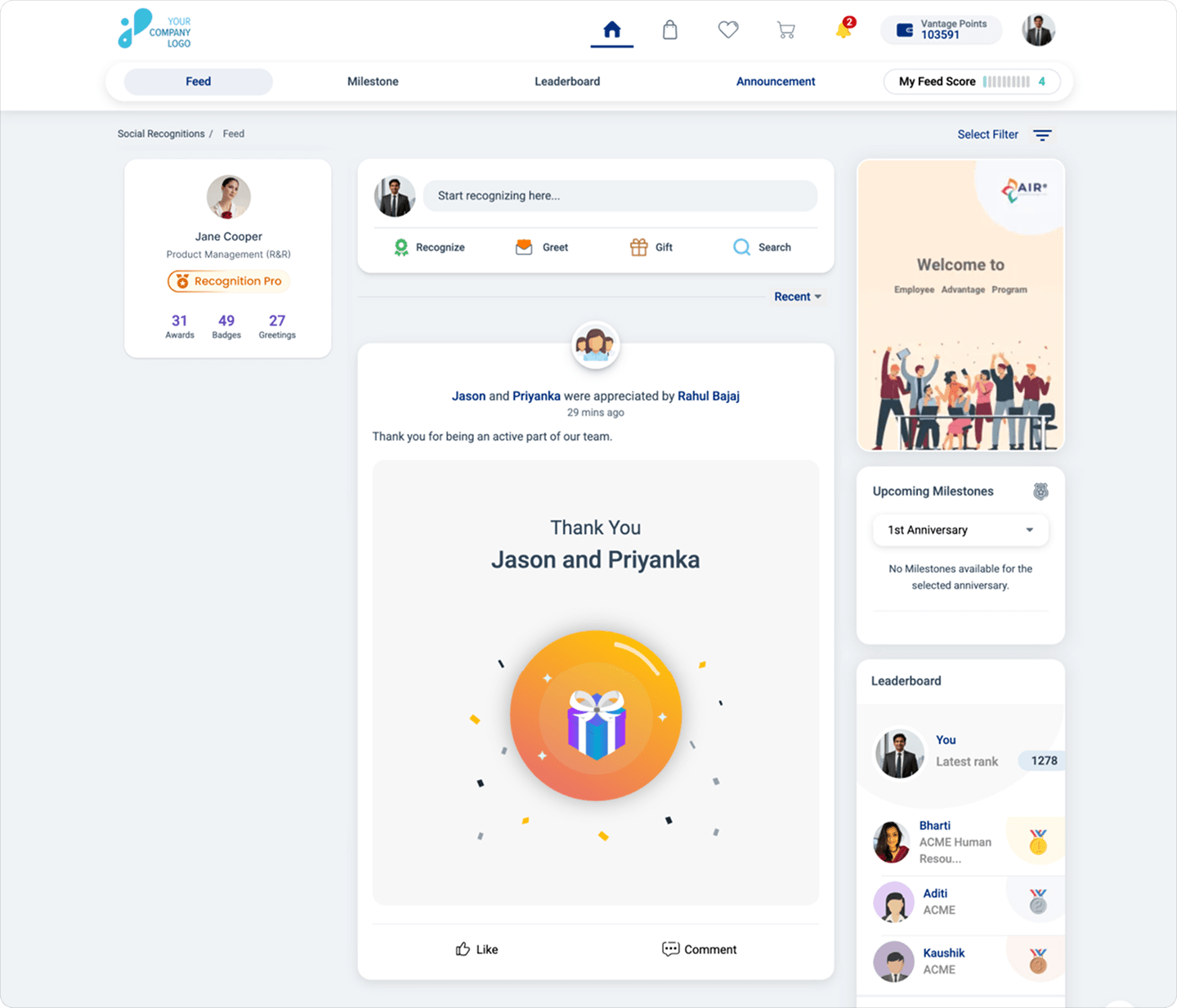
Think of a platform as backup for the habit, not a substitute for the letter itself. A manager who's building the habit of writing recognition letters regularly still benefits from one that surfaces who hasn't been recognized lately, before that gap shows up as a resignation. The letter stays personal. The platform just makes sure fewer people fall through the cracks between letters.
A letter is still worth writing. It just doesn't have to be the only form recognition takes.
FAQs About Employee Recognition Letters
How to write a letter of recognition for an employee?
Start with a direct expression of thanks, name the specific accomplishment or behavior you're recognizing, describe its impact, and close on a positive note. Keep it personal to that employee rather than generic enough to send to anyone.
What is an example of employee recognition statement?
"Your work on the Denver pitch last month, rebuilding the deck the night before with two hours' notice, is why we kept that account." A good recognition statement names the specific action and its outcome, not just that the work was "great."
What is an example of a good appreciation letter?
A good appreciation letter names one specific thing the employee did, explains why it mattered, and is signed by someone who was actually involved or affected, not sent as a blanket message to a distribution list. The "For Outstanding Performance" and "For Customer Service Excellence" examples above follow this structure.
What is a good recognition sentence?
A good recognition sentence answers "what, specifically, did this person do" in one line. For example: "You flagged the scheduling conflict two weeks before the launch, which gave the team enough runway to fix it without anyone scrambling." Avoid sentences that only say someone "did a great job" without naming the job.
What is an example of a simple appreciation letter?
A simple appreciation letter can be two or three sentences: a thank-you, the specific reason for it, and a closing line of appreciation. The "Recognition Letter Between Peers" example above is intentionally short and works well as a template for this.
What is an example of recognition award wording?
Recognition award wording typically names the achievement, the timeframe, and the impact: "In recognition of outstanding contribution to [project/goal] during [timeframe], for [specific impact]." Keep it factual and specific rather than generic, the same rule that applies to a full recognition letter applies here in miniature.
Conclusion
None of the 10 examples above are meant to be used exactly as written. Pick the one closest to your situation, swap in a real detail only you'd know, and send it before the week is out, while the specifics are still sharp enough to matter. Most of what you'll find searching for this topic skips that step. It's the only one that actually makes a recognition letter worth writing.

Lupamudra is a content marketing specialist at Vantage Circle, where she has written 50+ articles on employee recognition, rewards, and workplace culture, alongside employee engagement, diversity and inclusion, and HR compliance topics, including how India's tax rules apply to recognition and rewards programs.
Connect with Lupamudra on LinkedIn.